Glass veil, paper tape or mesh: which drywall joint tape to use
Team VELOBOX · Last updated 10 July 2026 · 6 min read
Glass veil, paper tape or fibreglass mesh? A practical comparison of drywall joint tapes: pros, cons and which one to use where.
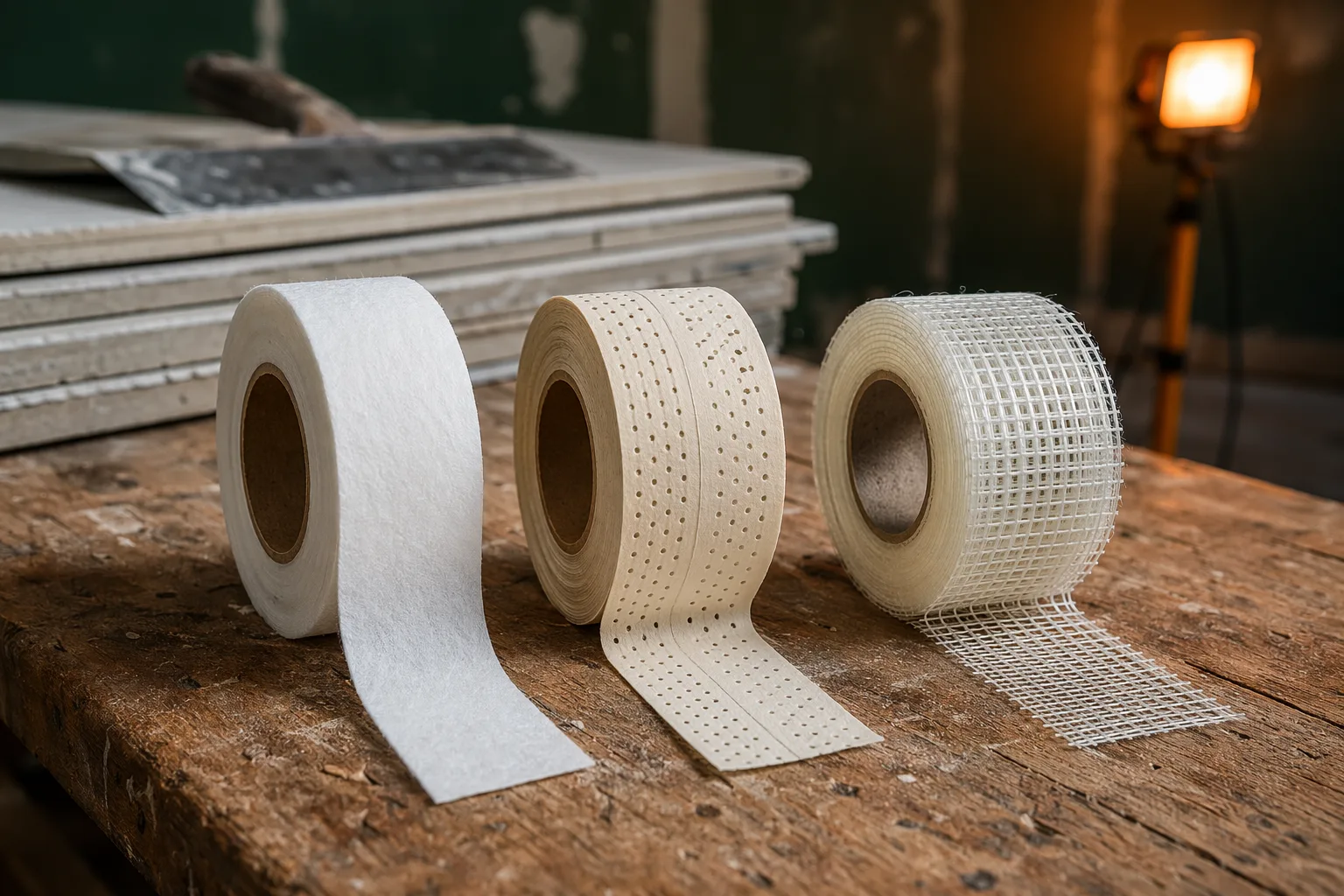
On the flat and square-cut joints of drywall the most practical tape is glass veil, bedded into the compound; on factory-tapered joints and internal corners the standard remains paper tape. Self-adhesive fibreglass mesh is the fastest for repairs and small jobs, but it must be paired with a setting compound to avoid crack risk.
In this guide we compare the three drywall reinforcing tapes — glass veil, paper tape and fibreglass mesh — against the criteria that really matter on site: strength, thickness, laying speed, behaviour on corners and cracking risk.
For a focus on glass veil alone — what it is, grammage and roll sizes — see the dedicated guide to fiberglass drywall tape (glass veil).
In short
- Glass veil: flat and square-cut joints, minimal thickness, fast to lay (no soaking).
- Paper tape: tapered joints and internal corners (90° fold), maximum tensile strength.
- Self-adhesive mesh: fast for repairs and holes, but only with a setting compound (or it cracks).
- None is “the best”: you choose by joint type.
The three reinforcements compared
| Criterion | Glass veil | Paper tape | Self-adhesive mesh |
|---|---|---|---|
| Laying | Bedded into fresh compound | Bedded into fresh compound | Self-adhesive, applied dry |
| Thickness | Minimal | Low | Highest (grid) |
| Strength | High, uniform in every direction | Maximum in tension | Medium, elastic |
| Crack risk | Low | Low (if well bedded) | Higher with ready-mixed compounds |
| Internal corners | Good | Excellent (90° fold) | Not recommended |
| Speed | High, one-handed with a dispenser | Low | Highest |
| Ideal for | Flat and square-cut joints, patches | Tapered joints, corners | Repairs, holes, cracks |
← scorri per vedere tutto →
None of the three is “the best” outright: each is made for a different joint. Let us look at them one by one.
Glass veil: minimal thickness, fast laying
Glass veil is a non-woven glass fibre web. It is laid by bedding it into the first coat of fresh compound, like paper, but with two practical advantages: it does not need soaking and has an almost zero thickness, which leaves a flatter surface for the following skim.
The randomly arranged fibres (not a grid) give it uniform strength in every direction: that is why it works well on flat and square-cut joints — the live edges of the boards, the patches, the junctions — where paper is harder to lay to a high standard. It is the tape with the best balance of strength, thickness and speed, especially when fed by a dispenser that keeps it taut and clean.
The step-by-step application is described in the guide how to apply glass veil on drywall joints.
Paper tape: the standard on tapered joints and corners
Paper tape is the historic jointing tape: the micro-perforations let the compound through, locking it in the joint to create the strongest reinforcement in tension. It works excellently in the recess of factory-tapered joints (the thinned edges of the boards) and remains unbeatable on internal corners, where it folds 90° along its pre-formed crease and draws a sharp corner.
The downside is the laying: it must be bedded carefully to avoid air bubbles under the paper — the defect that later shows as a bulge in raking light — and some products need dampening first. It is the slowest of the three, and the one that least forgives a poor hand.
Self-adhesive mesh: the fastest, but choose the compound well
Self-adhesive fibreglass mesh is applied dry directly on the joint, without a bed of compound: that is why it is the fastest and the typical choice for repairs of cracks, holes and small jobs. But the grid has two structural limits: it builds more thickness (wider skims are needed to cover it) and it is elastic.
The elasticity is the critical point: with an ordinary ready-mixed finishing compound, the mesh follows the boards’ micro-movements and the joint can crack. That is why it must be paired with a setting compound (chemical cure), stiffer and tougher. On long, visible joints — and on corners — glass veil or paper are better.
Which tape to choose, joint by joint
- Factory-tapered joint → paper tape (or glass veil, if you want faster laying).
- Flat or square-cut joint → glass veil: minimal thickness where there is no recess to hide it.
- Patches and junctions → glass veil, more forgiving on irregular surfaces.
- Internal corner → paper tape folded 90°; alternatively glass veil laid taut.
- Crack and hole repair → self-adhesive mesh + setting compound.
- External sharp corners → none of the three: you need corner beads.
Whichever tape you choose, the level of finish over the reinforced joint — from Q1 to Q4 — follows the drywall finishing levels. A clean tape application is the base for reaching them.
The mistakes to avoid with each tape
- Bedding glass veil or paper badly (bubbles, creases, slack tape): the reinforcement does not work and the defect shows in raking light.
- Covering mesh with ready-mixed compound: elastic joint, crack almost guaranteed over time.
- Skimming too thin over mesh: the grid “prints” through the finish.
- Unrolling and cutting freehand: inconsistent tension and frayed edges, on any tape — this is the phase where most time and precision are lost.
Three materials, one applicator
It is precisely for this choice — glass veil, paper or mesh depending on the joint — that VELOBOX was designed with three interchangeable adapters: one for glass veil (it is the only dispenser on the market compatible with this material), one for paper tape and one for reinforcing mesh. You change roll in seconds without tools, feed with one hand at constant tension and cut with the integrated blade, whatever reinforcement the joint needs.
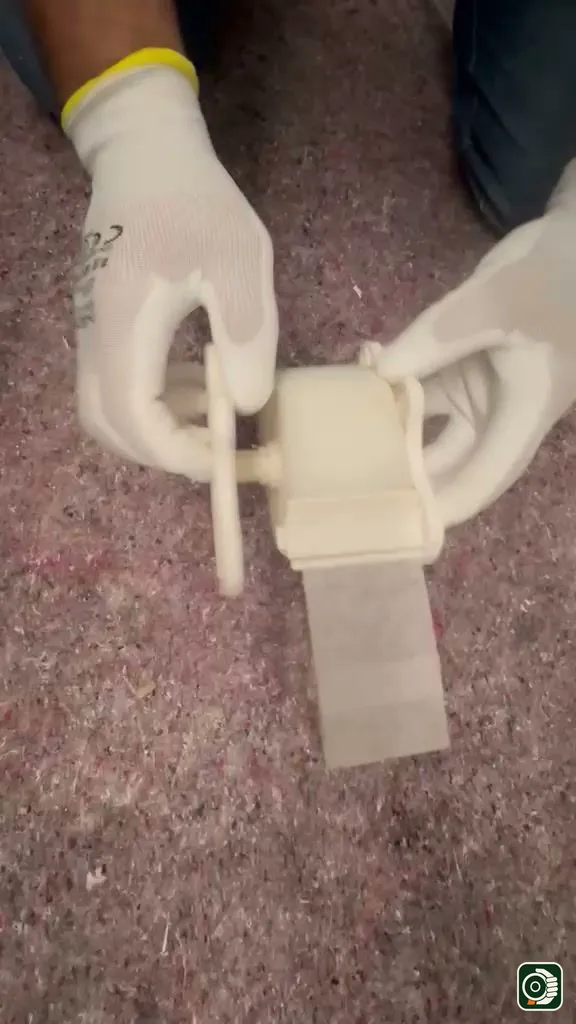
See the VELOBOX instructions with the adapter change for the three materials.
Frequently asked questions
What is the difference between glass veil and fibreglass mesh? Both are glass fibre, but glass veil is a thin non-woven web bedded into fresh compound; mesh is a thicker, elastic self-adhesive grid applied dry. The veil adds less thickness and less crack risk; mesh is faster for repairs.
Which is the strongest drywall joint tape? In pure tension, well-bedded paper tape. Glass veil offers the best balance of strength, thickness and ease of laying; mesh is the weakest with ready-mixed compounds.
Does self-adhesive drywall mesh make joints crack? With ready-mixed finishing compounds the risk is there: the grid is elastic and the joint moves. With a setting compound the risk drops a lot. For long, visible joints, glass veil or paper are better.
Which tape to use on internal drywall corners? Paper tape folded 90° is the standard. Glass veil works if laid taut; mesh is not recommended.
Want to try VELOBOX first? Join the waitlist.
Related articles
- Tools to apply glass veil: by hand, banjo or dispenser Which tool do you need to apply glass veil on drywall? A practical comparison of hand method, banjo, mesh applicators and a belt dispenser.
- Fiberglass drywall tape (glass veil): what it is, weight and sizes What fiberglass drywall tape (glass veil) is: a non-woven glass fibre web that reinforces drywall joints. Weight, width, roll sizes and how to apply it.
- How to apply glass veil on drywall joints How to apply glass veil on drywall joints: the 5 correct steps, the tools and the mistakes to avoid for a crack-free skim finish.
Apply the tape faster with VELOBOX
Join the waitlistAre you a reseller or distributor? Discover the dealer programme →