Fiberglass drywall tape (glass veil): what it is, weight and sizes
Team VELOBOX · Last updated 10 July 2026 · 8 min read
What fiberglass drywall tape (glass veil) is: a non-woven glass fibre web that reinforces drywall joints. Weight, width, roll sizes and how to apply it.
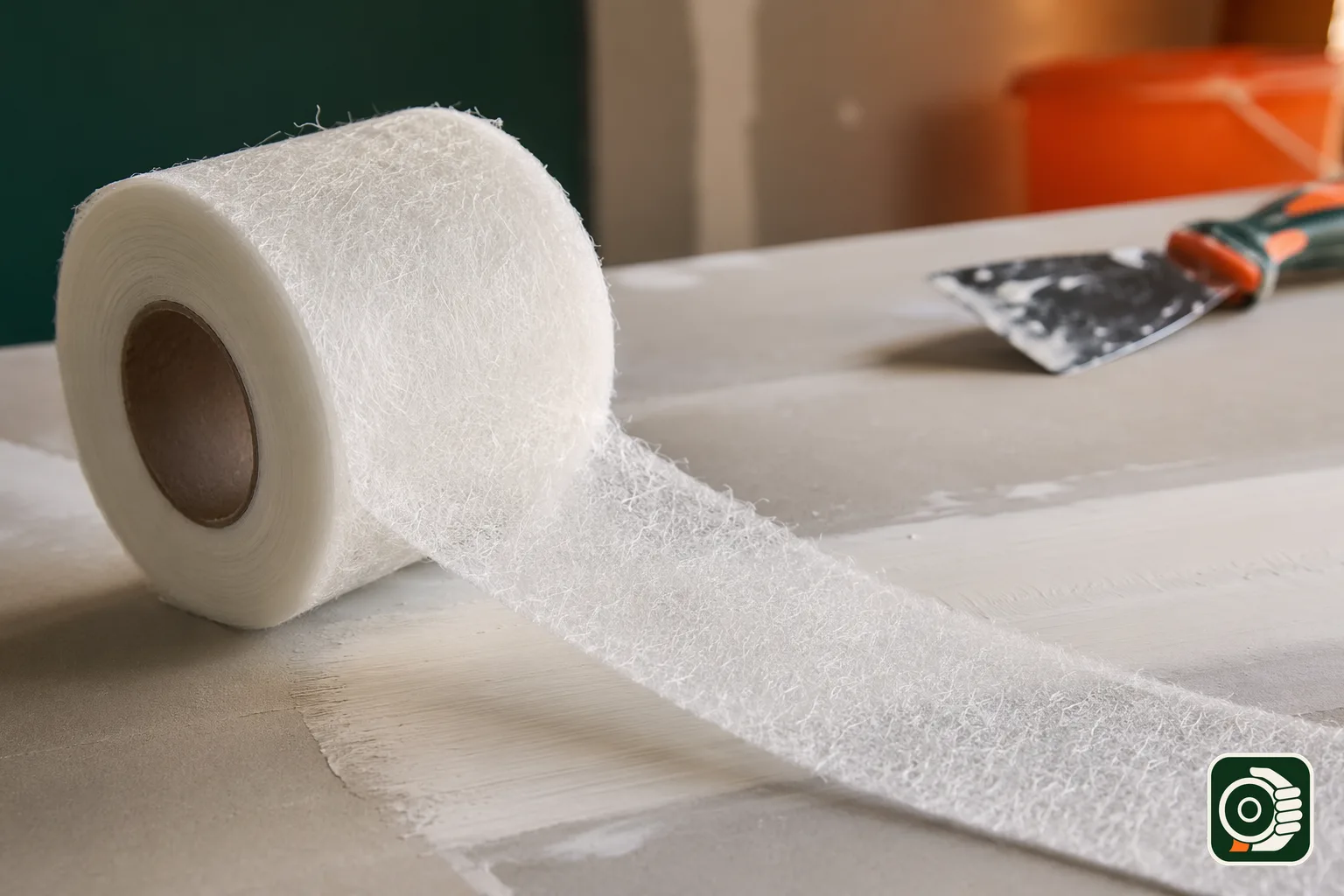
Fiberglass drywall tape — the glass veil — is a non-woven glass fibre web, usually 50 mm wide, that is bedded into fresh joint compound to reinforce drywall joints and prevent cracks. It weighs about 50 g/m², has minimal thickness and — unlike paper tape — does not need to be soaked before application.
This guide covers what glass veil is, its technical characteristics (weight, width, roll sizes), what it is really for on site and how it differs from the other joint tapes. It is the reference sheet on the material; for the step-by-step application and the comparison with mesh and paper, see the dedicated guides linked below.
In short
- Glass veil is a non-woven glass fibre web (approx. 50 mm wide) to bed into joint compound.
- Typical grammage ~50 g/m², minimal thickness; it does not need soaking (unlike paper tape).
- It is a veil, not a mesh: random fibres → uniform strength in every direction.
- Also called: glass fibre veil, fibreglass tissue, glass fibre joint tape; joint format 50 mm × 25–45 m.
What glass veil is (and why it is called that)
Glass veil is a non-woven glass fibre web: extremely fine glass fibres arranged randomly and bonded together into a continuous felt. It is neither woven nor knitted — and that is precisely the difference that matters against fibreglass mesh, which is instead a regular grid.
The random arrangement of the fibres gives the veil uniform strength in every direction: it has no stronger “grain” and weaker one like a mesh. Bedded into the compound, it creates a continuous reinforcement that spreads the micro-movements of the boards over a wider band, preventing the classic crack along the joint.
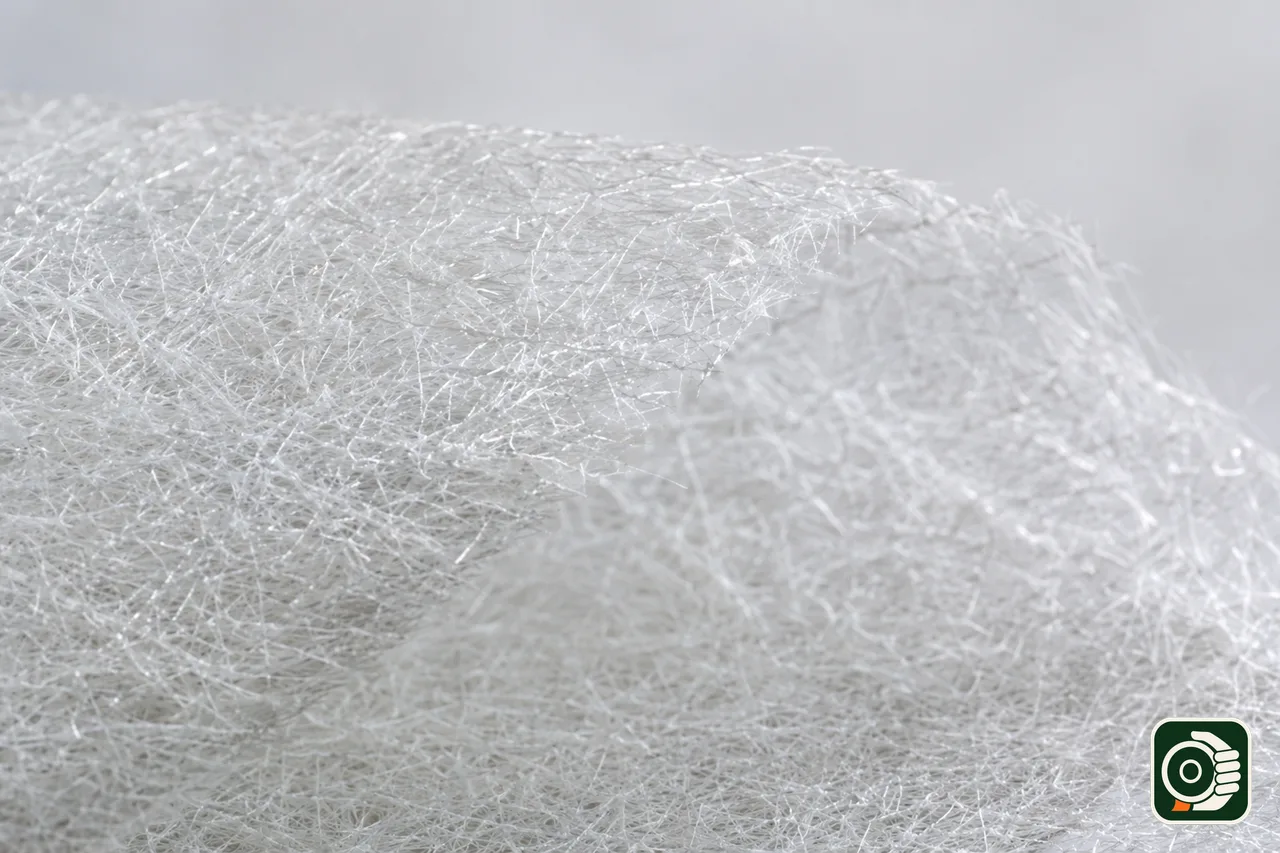
The name changes from site to site and catalogue to catalogue, but the material is always the same. You will find it as:
- glass veil or glass fibre veil (the most common form)
- fibreglass tissue or glass fibre tissue
- non-woven glass tape
- fibreglass joint tape (bedded type)
They are synonyms. The only real terminology trap is confusing it with fibreglass mesh: same base material, but completely different structure, thickness and way of applying.
Technical characteristics of glass veil tape
Specifications vary a little between manufacturers, but glass veil tape for drywall joints has fairly constant reference values:
| Characteristic | Typical value |
|---|---|
| Material | Non-woven glass fibre web |
| Grammage | ~50 g/m² (lighter variants ~35, heavier up to ~75) |
| Width | 50 mm (the standard for joints) |
| Roll length | from 25 m (counter sale) up to 45 m and beyond (professional) |
| Thickness | Minimal, fractions of a millimetre |
| Application | Bedded into the first coat of fresh compound |
| Fire behaviour | Non-combustible (glass fibre does not burn) |
| Moisture sensitivity | Stable: it does not swell and is not soaked before application |
← scorri per vedere tutto →
Two numbers deserve a comment. The grammage is the figure that sets products apart: a veil around 50 g/m² is the right compromise between strength and thickness for joint finishing; lighter veils (~35 g/m²) lay even more invisibly but are meant more to line surfaces than to reinforce live joints, while heavier ones (~70-75 g/m²) are reserved for tough repairs and substrates that move a lot. The practical rule on site is simple: for drywall joints, stay with the white 50 g/m² veil and only step up in grammage where cracking is a recurring problem. The 50 mm width is almost an industry unit of measure: it covers the joint plus enough board margin to anchor the reinforcement well — and it is the format the application accessories are calibrated on, VELOBOX included.
How to recognise a good glass veil: it is a uniform white, has a soft, slightly “wooly” feel (the fibres are not glued into a rigid mesh) and tears clean across the width without stringing. A veil that is too open lets the compound show through and reinforces less; one that is too dense builds thickness and skims worse. Be wary of rolls with frayed edges or fibres that come off already to the touch: they lay badly and leave fluff in the compound.
Glass veil has a single but decisive job: to reinforce the joint between two boards so it does not crack. Two adjacent panels move slightly differently as temperature and humidity change; without a tape binding the two edges, sooner or later the joint cracks and the line shows through the paint.
Glass veil works particularly well on butt (square-cut) joints — the cut sides of the boards, the patches, the junctions — where there is no factory taper to hide the tape and you therefore need the thinnest possible thickness. It is also the choice of anyone after a flatter surface for skimming to the higher finishing levels.
The application principle is simple: a first bed of compound, the glass veil bedded and pulled tight, a second covering coat, then sanding and skimming. The full sequence, with tools and mistakes to avoid, is in the guide on how to apply glass veil on drywall joints. The level of finish over the reinforced joint — from Q1 to Q4 — follows the internationally used drywall finishing levels.
Glass veil, mesh or paper: the differences in brief
Glass veil is not the only reinforcing tape, and it is important not to confuse it with the other two:
- Glass veil — non-woven web, bedded into the compound. Minimal thickness, smooth finish, ideal on butt and square-cut joints.
- Paper tape — the historic tape, maximum tensile strength, unbeatable on factory-tapered joints and internal corners.
- Self-adhesive fibreglass mesh — elastic grid applied dry, very fast for repairs but thicker and, over setting compounds, more prone to cracking.
The full comparison, joint by joint, is in the guide glass veil, paper tape or mesh: which one to use.
How much glass veil costs and where to buy it
Consumption is easy to estimate: about 1 metre of tape for every linear metre of joint, plus a small margin for junctions and cuts. A 45 m roll therefore covers about 45 metres of joint net of offcuts: to give an idea, a room with a few walls and a ceiling is measured in tens of metres of joint, so it is normal to use several rolls per job.
On cost, glass veil is one of the cheapest consumables in jointing: a few euros per roll, well below the cost of the compound needed to lay it. The real expense is not the tape, it is the application time.
It is found at builders’ merchants, specialist drywall suppliers, some hardware stores and online; the most common brands are Knauf, Gyproc (Saint-Gobain) and others. One useful note for anyone looking for glass veil in large DIY chains: there the “fibreglass joint tape” on the shelf is almost always the self-adhesive mesh, not the veil — the classic bedded veil is far easier to find at trade suppliers or online. When buying, check two things: that it is the bedded version (not self-adhesive) if you want the best finish, and the 50 mm width, the standard for joints.
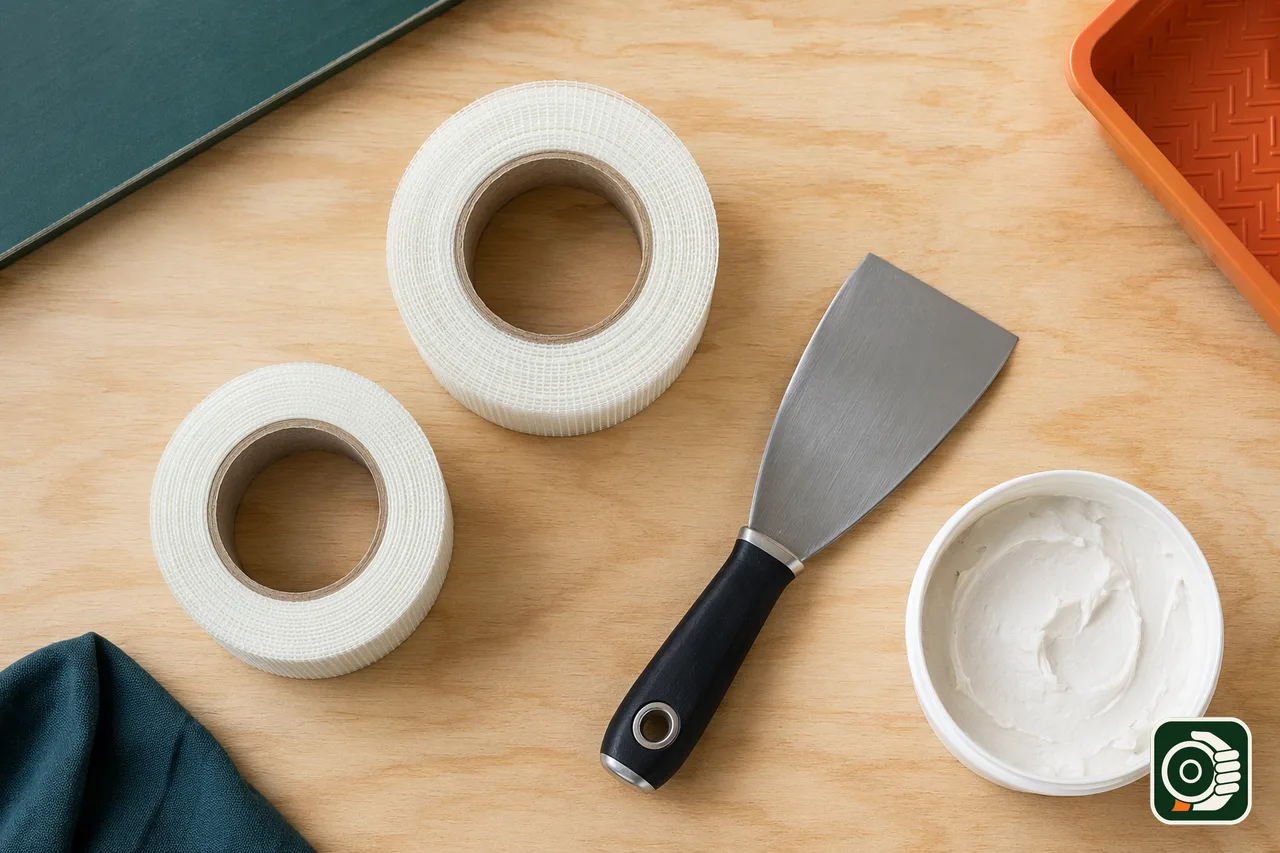
How to apply it, in brief
For those who just want the application summary:
- Spread a first coat of setting compound along the joint.
- Bed the glass veil into the fresh compound, pulling it tight with the knife to remove bubbles and creases.
- Cover with a second coat of compound, feathering the edges to zero.
- Once dry, sand and skim to the required finishing level.
The bottleneck is not the material, it is the repeated motion: unroll, tension, cut, dozens of times. That is exactly the problem VELOBOX was born to solve — the dispenser that feeds glass veil (and also paper tape and mesh) with a single hand, at constant tension and with a clean integrated cut — the only applicator on the market compatible with glass veil.
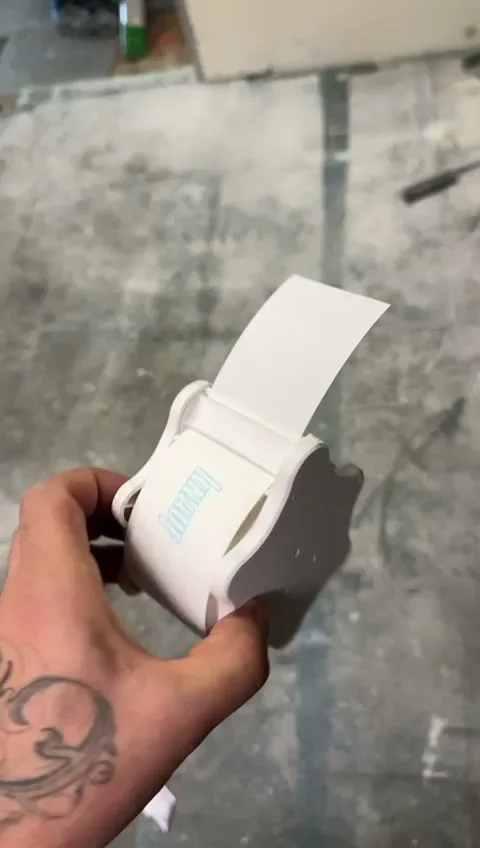
See also the step-by-step VELOBOX instructions with the three adapters for glass veil, paper tape and mesh.
Frequently asked questions
What is glass veil (fiberglass joint tape)? It is a non-woven glass fibre web: a thin tape with randomly arranged fibres, bedded into fresh compound to reinforce drywall joints. It is also called glass fibre veil or fibreglass tissue.
How much does glass veil weigh? What is its grammage? Joint tape has a typical grammage of around 50 g/m². Lighter veils (~35 g/m²) and heavier versions (up to ~75 g/m²) exist; for drywall joints the reference is the white veil at about 50 g/m².
What is the difference between glass veil and fibreglass mesh tape? They share the base material (glass fibre) but not the structure. Glass veil is a non-woven web bedded into the compound; mesh is a thicker, self-adhesive elastic grid applied dry.
Where do you buy fiberglass drywall tape? At builders’ merchants, specialist drywall suppliers, some hardware stores and online. In large DIY chains the fibreglass tape on the shelf is almost always the self-adhesive mesh: the bedded veil is easier to find at trade suppliers. Most common format: 50 mm roll, from 25 m up.
Is glass veil self-adhesive? The classic professional version is not self-adhesive: it is bedded into fresh compound. Self-adhesive veils exist too, faster but with a slight thickness. For the best finish the bedded version is preferred.
Want to try VELOBOX first? Join the waitlist.
Related articles
- How to apply glass veil on drywall joints How to apply glass veil on drywall joints: the 5 correct steps, the tools and the mistakes to avoid for a crack-free skim finish.
- Glass veil, paper tape or mesh: which drywall joint tape to use Glass veil, paper tape or fibreglass mesh? A practical comparison of drywall joint tapes: pros, cons and which one to use where.
- Tools to apply glass veil: by hand, banjo or dispenser Which tool do you need to apply glass veil on drywall? A practical comparison of hand method, banjo, mesh applicators and a belt dispenser.
Apply the tape faster with VELOBOX
Join the waitlistAre you a reseller or distributor? Discover the dealer programme →